If You Want AI to Cite You, Give It a Clean Definition It Can Reuse
If you want better SEO, you usually think about keywords.
If you want better AEO and GEO, you also need to think about answers.
One of the highest-leverage changes you can make to a blog post is adding a short definition block early in the article.
Not as a gimmick. Not as filler. Not as another SEO trick.
As a clarity device.
A definition block helps humans understand the page faster. It helps search engines identify the main entity. It gives AI systems a stable chunk of content that can be retrieved, summarized, and referenced more safely.
Most teams bury definitions halfway down the page. That makes the article harder to scan and harder to cite.
Definition blocks fix that.
What Is a Definition Block?
A definition block is a short structured section near the top of a page or article that defines the main concept clearly.
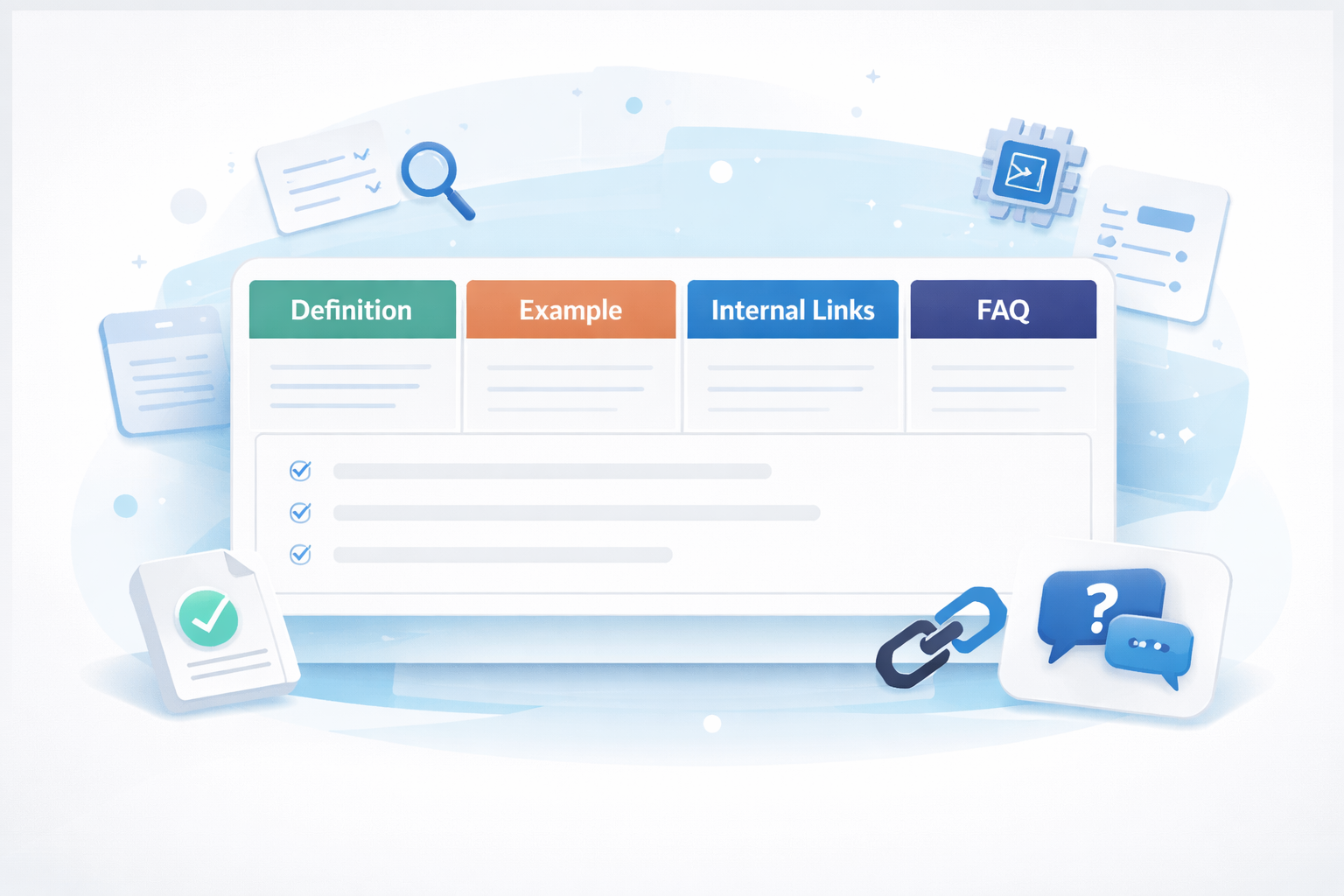
It usually includes a one- or two-sentence definition, a quick clarification of what the concept is and is not, one practical example, and internal links to deeper supporting pages.
The goal is to make the page’s main entity obvious.
A simple definition block might include:
- a one- to two-sentence definition;
- a quick “what it is and is not” clarification;
- one example;
- one or two internal links to deeper context.
That is enough to make the page more understandable without slowing the reader down.
Why Definitions Matter More in SEO, AEO, and GEO
Search has become more answer-driven.
People do not only search for keywords. They ask full questions, compare concepts, request summaries, and rely on AI systems to explain topics quickly.
That changes how content needs to be structured.
If your page is about a specific concept, the page should define that concept clearly. If the definition is vague, buried, or scattered across multiple paragraphs, the page becomes harder to understand.
Definition blocks support three visibility layers:
- SEO: they clarify the main topic and support search intent.
- AEO: they provide direct answers that can be used by answer engines.
- GEO: they make the page easier for generative AI systems to summarize and cite accurately.
The point is not to manipulate search systems. The point is to write in a way that makes the answer easier to find, understand, and trust.
Why Burying the Definition Weakens the Page
Many articles start with a long story, a broad opinion, or several paragraphs of context before defining the core concept.
That can work in some editorial formats, but it often weakens educational and search-focused content.
If someone lands on a post about attribution models, they should not need to scroll halfway down the page to understand what an attribution model is. If someone lands on a post about topic clusters, they should get a clear definition early. If someone lands on a post about AI-citable pages, the page should quickly explain what makes a page citable.
When definitions are buried, the page creates friction.
That friction affects:
- human scanability;
- search intent satisfaction;
- AI summarization;
- entity clarity;
- internal linking consistency;
- zero-click answer potential;
- reader trust.
The reader should not have to hunt for the basic answer.
The Simple Definition Block Formula
A strong definition block does not need to be long.
Use this simple formula:
- Definition: explain the concept in one or two clear sentences.
- Clarification: explain what it is and what it is not.
- Example: show the concept in a practical context.
- Internal links: point to one or two deeper resources.
This gives the page a clean answer unit near the top.
It also helps the rest of the article stay focused because the main entity has already been defined.
Example Definition Block
Here is a simple example for a post about topic clusters:
Topic clusters are groups of related pages built around one central topic. A pillar page covers the broad subject, while cluster posts answer specific subtopics and link back into the system. Topic clusters are not just a blog category; they are a structured way to build topical authority and guide readers from broad questions into deeper answers.
That block gives the reader a clear definition, explains what the concept is not, and creates a natural path to deeper cluster content.
For a real supporting page, link to topic clusters.
Definition Blocks Help Humans Scan Faster
Most readers do not read a post from top to bottom on the first pass.
They scan.
They look for the answer, check whether the page is relevant, and then decide whether to keep reading.
A definition block helps them decide quickly.
It tells them:
- what the page is about;
- whether the page matches their question;
- how the writer defines the concept;
- where to go next if they need more context.
This is especially useful for technical, strategic, or systems-based content where terminology can become confusing quickly.
Definition Blocks Help AI Systems Understand the Page
AI systems work better when content has clear, reusable answer units.
A definition block gives the model a stable explanation of the main concept. It reduces ambiguity and makes the page easier to summarize.
This does not guarantee that an AI system will cite the page. Nothing can guarantee that. But a clean definition makes the page more citation-ready because the answer is easier to identify and reuse accurately.
This connects directly to AI-citable pages. The best AI-citable content is not written to trick retrieval systems. It is written to make meaning clear.
Definition Blocks Strengthen Entity SEO
Entity clarity matters because search engines and AI systems need to understand what the page is mainly about.
A definition block helps connect the page to a specific entity.
For example:
- A post about UTMs should define what UTMs are and link to UTM discipline.
- A post about content architecture should define the content system and link to topic clusters.
- A post about AI visibility should define SEO, AEO, and GEO, then link to SEO vs AEO vs GEO.
- A post about AI citation readiness should link to AI-citable pages.
This makes the content graph more coherent.
Each page defines its own entity and points readers to the best supporting context.
Definition Blocks Improve Internal Linking Discipline
Definition blocks also improve internal linking because they create a natural place to standardize anchors.
If every time you mention “topic clusters” you link to the same pillar or primary guide, you create a consistent internal graph. If every post uses a different phrase for the same concept, the signal becomes weaker and the reader experience becomes less predictable.
This is where definition blocks connect to internal linking for conversion.
The definition block can include:
- the main entity link;
- one supporting deeper article;
- one related service path when implementation intent is relevant.
The goal is not to stuff links into the opening. The goal is to make the content architecture easier to navigate.
Where Definition Blocks Fit Inside the Article
Definition blocks usually work best near the top of the article.
A practical structure looks like this:
- Opening H2 that frames the problem or thesis.
- Short introduction that explains why the topic matters.
- Definition block that clearly defines the main concept.
- Deeper sections that explain examples, frameworks, mistakes, and implementation.
- FAQ section that answers related next questions.
- Final CTA or implementation path.
The definition should appear early enough to support the rest of the article, but not so abruptly that the page feels mechanical.
How Definition Blocks Support FAQ Engineering
Definition blocks and FAQ sections work well together.
The definition block gives the main answer early. The FAQ section answers the related questions that come later.
For example, a post about definition blocks might define the concept near the top, then answer questions such as:
- Where should definition blocks appear?
- How long should they be?
- Do they help AI citations?
- Should every blog post include one?
- How do they connect to internal linking?
This supports FAQ engineering. A page becomes more useful when the definition and FAQs work together instead of repeating each other.
Definition Blocks Should Match Search Intent
Not every definition block should look exactly the same.
The definition should match the intent of the page.
For an informational article, the definition should be direct and educational. For a comparative article, the definition may need to clarify the difference between related terms. For a transactional page, the definition should connect the concept to the service or implementation path.
This is why definition blocks connect to search intent mapping.
The page should define the thing the reader actually came to understand.
Common Definition Block Mistakes
Definition blocks are simple, but they can still be done badly.
Avoid these mistakes:
- Making the definition too vague. A definition should explain the concept clearly, not hide behind buzzwords.
- Making the block too long. If the definition becomes a full essay, it stops being a quick clarity device.
- Burying the definition. The definition should appear early enough to help the reader.
- Using circular language. Do not define a term by repeating the same term in a different order.
- Skipping the example. Examples make abstract concepts easier to understand.
- Linking randomly. Internal links should point to genuinely deeper context.
- Overpromising AI citations. Definition blocks improve citation-readiness, but they do not guarantee citation.
- Using inconsistent anchors. Keep entity language clear across related posts.
A Practical Definition Block Template
Here is a repeatable template:
[Concept] is [clear one-sentence definition]. It helps [audience] do [practical function] by [mechanism]. It is not [common misconception]. For example, [simple example]. For deeper context, see [internal link 1] and [internal link 2].
This template can be adapted for blog posts, service pages, pillar pages, glossary sections, and FAQ-led content.
The key is to keep it clear, specific, and tied to the article’s main entity.
How to Add Definition Blocks Across Existing Content
Definition blocks are especially useful for content optimization projects.
If you already have a library of posts, start with the articles that define important entities or support major service categories.
Prioritize posts about:
- SEO, AEO, and GEO;
- UTMs and attribution;
- event naming;
- topic clusters;
- intent routing;
- lifecycle stages;
- lead scoring;
- AI agents;
- workflow orchestration;
- CRM data hygiene.
For each post, identify the primary entity, write a clean definition, add one example, and link to the best supporting pages.
This can improve clarity across the entire content system without needing to rewrite every article from scratch.
Where This Fits Inside a Connected Content System
Definition blocks are small, but they support a larger content architecture.
They clarify entities, strengthen internal linking, improve scanability, support FAQ engineering, and make posts easier for humans, search engines, and AI systems to understand.
For Veltiqo, this belongs inside Organic SEO & AEO Optimization, because definition blocks are part of practical SEO, AEO, and GEO implementation.
It also connects to the broader SEO / AEO Optimization category, where content architecture, answerability, and AI discoverability are core themes.
For businesses that want definition blocks, topic clusters, internal linking, FAQ engineering, and organic visibility working together, The Visibility Engine is the natural bundle path.
Final Thought: Make the Meaning Easy to Reuse
Definition blocks are not complicated.
That is why they work.
They give the reader the answer early. They give search engines a clearer entity signal. They give AI systems a cleaner explanation to retrieve. They give your internal linking strategy a natural anchor point.
If you want content to rank, answer, and get cited more easily, start by making the meaning easier to reuse.
Define the concept clearly.
Then build the rest of the page around it.